
Payment Transaction stages
Commerce Hub for Platforms supports the complete payment acceptance lifecycle, allowing platforms to authorize, capture, settle, and manage payments throughout the transaction journey. Depending on the business model and payment flow, transactions may follow either a two-step authorization and capture process or a single-step sale process.
- Authorization – Validates the payment method and confirms that sufficient funds or credit are available. The authorized amount is reserved by the issuer or processor but is not yet submitted for settlement.
- Capture – Completes a previously authorized transaction by capturing the approved funds and submitting the transaction for clearing and settlement.
- Sale – Combines authorization and capture into a single transaction request, enabling the transaction to proceed directly to settlement without a separate capture step.
- Refund – Returns funds to the original payment method for a previously settled transaction, either in full or for a partial amount.
- Void – Cancels an authorization or reverses a transaction before settlement processing is completed, releasing the reserved funds back to the cardholder.
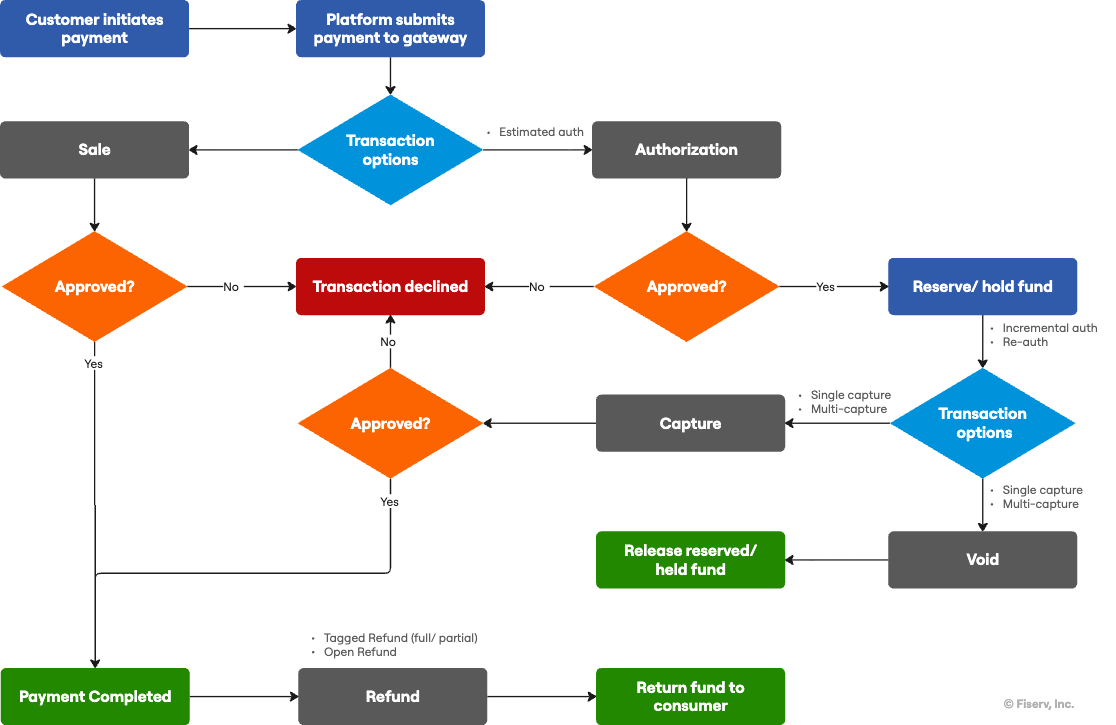
These transaction stage provide the flexibility to support a wide range of payment experiences, from immediate purchases and delayed fulfillment scenarios to post-transaction adjustments and customer refunds. However, the transaction states can be various per payment method.
Common Customer Outcomes and Use Cases
Authorization
Verify the payer's account and confirm that sufficient funds or credit are available before a transaction is completed. Authorization is the first step in the payment processing lifecycle and helps determine whether a transaction can proceed to capture and settlement. Depending on the business scenario, payment method, and processor capabilities, different authorization models may be used to support delayed fulfillment, estimated transaction amounts, or changes to the final amount after the initial approval.
Pre-Authorization
Places a temporary hold on funds before the final transaction amount is known or captured. Commonly used for eCommerce orders, hotels, restaurants, fuel purchases, and other scenarios where the final amount may change before settlement.
Reauthorization
Renews or extends a previously approved authorization when additional time is needed before capture or when the original authorization has expired. This helps ensure funds remain available until the transaction is finalized.
Estimated Authorization
Authorizes an estimated amount when the final transaction value is not yet known. Once the service is completed, the transaction may be adjusted and captured for the actual amount. Commonly used in lodging, vehicle rental, and other usage-based payment scenarios.
Incremental Authorization
Increases the amount of a previously approved authorization when additional charges are incurred after the original authorization. Commonly used in hospitality, transportation, healthcare, and other service-based transactions where the final amount exceeds the initial estimate.
The final outcome of an authorization request is determined by the payment processor and issuer. Authorization statuses, including approvals and declines, are returned through the standard transaction processing lifecycle and determine whether a transaction can proceed to subsequent activities such as capture, settlement, allocation, and payout processing.
Capture
Transfer previously authorized funds into the payment processing and settlement lifecycle once goods are shipped, services are delivered, or the final transaction amount has been confirmed. Capture is performed against an approved authorization and represents the point at which reserved funds are converted into a financial obligation for settlement. Depending on business requirements and processor capabilities, transactions may support either a single capture or multiple captures against the same authorization.
Single Capture
Captures all authorized funds in a single transaction. Commonly used when the entire order is fulfilled at one time and the final amount is known. After a successful capture, the transaction proceeds through settlement, allocation, and payout processing.
Multiple Captures
Captures authorized funds across multiple capture transactions against a single authorization. Commonly used for partial shipments, backordered items, staged order fulfillment, subscription deliveries, and other scenarios where products or services are provided over time rather than all at once. Each capture reduces the remaining available authorized amount until the authorization is fully utilized or expires.
The final outcome of a capture request is determined by the payment processor. Capture approval or decline statuses are returned through the standard transaction processing lifecycle and influence downstream activities including settlement, allocation, payout, reconciliation, and reporting.
Sale
Authorize and capture funds as part of a single payment transaction. A Sale transaction is commonly used when goods or services are delivered immediately and there is no need to separately manage authorization and capture events. Once approved, the transaction proceeds directly into settlement and downstream fund management activities such as allocation, payout, reconciliation, and reporting.
The final outcome of a Sale transaction is determined by the payment processor and issuer. Approval or decline statuses are returned through the standard transaction processing lifecycle and determine whether the transaction proceeds to settlement, allocation, payout, reconciliation, and reporting activities.
Void
Cancel a previously approved transaction before funds are settled. A Void is commonly used when an order is cancelled, a transaction was submitted in error, the payment amount needs to be adjusted, or goods and services will no longer be delivered. Because settlement has not yet occurred, a Void prevents funds from moving through the settlement process and eliminates the need for a subsequent refund.
Full Void
Cancels the entire authorized or captured transaction before settlement. Once approved, the transaction is removed from the settlement process and no funds are collected from the payer. Commonly used when an order is completely cancelled or a transaction was submitted in error.
Partial Void
Cancels a portion of the authorized or captured amount before settlement while allowing the remaining amount to proceed. Commonly used when an order total is reduced, an item is removed from a purchase, or the final amount is lower than originally authorized. Processor and payment method support may vary.
The final outcome of a Void request is determined by the payment processor. Void approval or decline statuses are returned through the standard transaction processing lifecycle. Successfully voided amounts do not proceed to settlement, allocation, payout, reconciliation, or other post-settlement activities such as refunds and chargebacks.
Refund
Return funds to the original payment method after a transaction has settled. Commonly used for product returns, service cancellations, customer satisfaction adjustments, billing corrections, or partial credits for undelivered goods and services. Once submitted, a refund request is evaluated by the payment processor and may be approved or declined based on processor rules, transaction eligibility, and other operational factors. Different refund types are supported, providing merchants with flexibility when returning funds to a payer.
Tagged Refund
A refund transaction that is linked to the original Sale or Capture transaction. The refund amount can be equal to or less than the original transaction amount. If no amount is specified, the system assumes a full refund of the original transaction amount.
Open Refund
A refund transaction that is not linked to a specific Sale or Capture transaction. Because the original transaction is not referenced, the refund amount must always be provided as part of the refund request.
The final outcome of a refund request is determined by the payment processor. Refund approval or decline statuses are returned through the standard transaction processing lifecycle and reflected in subsequent ledger, allocation, and reconciliation activities.