
Verification Requirements
Verification helps confirm that participant information satisfies the requirements needed to support onboarding, compliance obligations, participant activation, and access to platform services.
Verification requirements may vary based on participant type, business structure, jurisdiction, enabled capabilities, and applicable regulatory requirements.
This section explains the information required for verification, common verification workflows, verification outcomes, and remediation processes when additional review is required.
Why Verification Matters
Verification helps platforms:
- Confirm participant identity and business information
- Support regulatory and compliance obligations
- Reduce operational and financial risk
- Determine participant eligibility for platform services
- Enable participant activation
- Support ongoing compliance and monitoring requirements
Participants must satisfy applicable verification requirements before they can access enabled platform capabilities.
Verification Information Requirements
Verification requirements vary based on participant type.
| Participant Type | Verification Requirements |
|---|---|
| Platform | Legal business information, registration details, tax information, ownership, business activity, MCC, selected products |
| Individual Participant | Legal name, date of birth, address, identity or tax identifier, contact information, supporting evidence |
| Business Participant | Legal business name, registration details, entity type, business activity, addresses, owners, control persons, authorized representatives |
The information required depends on the participant's role, selected products, geography, and applicable compliance requirements.
Verification Process
Verification evaluates the information submitted during onboarding and determines whether additional review or supporting information is required.
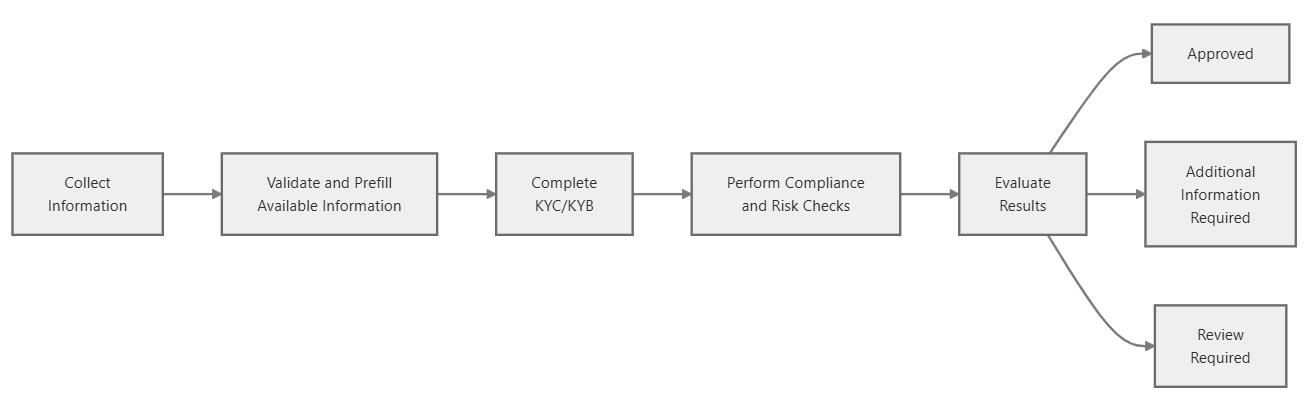
Verification activities may include identity verification, business verification, compliance screening, and risk-related reviews, depending on participant requirements.
Approved participants become eligible for activation and access to configured services.
Verification States
Participants generally progress through the following stages:
| State | Description |
|---|---|
| Submitted | Participant information has been received |
| Verification In Progress | Identity, business, compliance, and risk checks are being performed |
| Additional Information Required | Additional information or documentation is needed |
| Under Review | Manual or enhanced review is required |
| Approved | Participant is eligible for activation |
| Declined | Participant did not satisfy requirements |
State names and workflows may vary based on geography, participant type, and enabled capabilities.
Additional Information & Remediation
Verification cannot always be completed using the information initially provided.
When additional information is required:
- Onboarding may pause
- Additional documentation may be requested
- Verification reviews may be performed
- Participant status may remain pending until review is completed
Participant-facing communications should provide clear instructions without exposing:
- Internal risk rules
- Screening logic
- Vendor responses
- Confidential decision criteria
The remediation process may include:
- Additional information requests
- Document submission
- Offline review
- Enhanced verification
- Approval or decline notification
Factors That Influence Verification Requirements
Verification requirements may vary based on:
- Participant type
- Business structure
- Jurisdiction or operating region
- Regulatory obligations
- Enabled platform capabilities
- Applicable compliance requirements
Examples
Individual Seller / Sole Proprietor
Verification requirements typically focus on identity validation and individual eligibility reviews.
Business Entity
Verification requirements may include business validation, ownership verification, control person verification, and business structure review.
Best Practices
- Collect complete participant information during onboarding
- Minimize duplicate information collection where possible
- Communicate verification status clearly
- Provide clear remediation instructions when additional information is required
- Reuse verified participant information across enabled services when permitted
- Maintain current participant information throughout the participant lifecycle
- Preserve verification history and audit records